
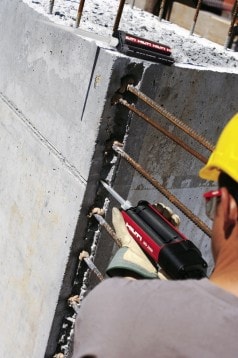


Post-installed rebar application
Nowadays, addition and alternation (A&A) works for reinforced concrete structures connections such as column-to-slab and slab-to-wall or structural strengthening by using reinforcing bars inserting into existing concrete structures with adhesive, hybrid or cementitious grouting system are commonly named as post-installed rebar system. This system is cost-effective, convenient and flexibility in design and construction. However, engineers are seldom to consider the qualification, acceptance and installation certification of the system behind. This article will give the introduction for the qualification this system.
Other than considering the failure mode of concrete cone and pull-out, the concern for post-installed rebar system is to qualify the adhesive or grouting material for post-installed rebar system combined with the certified installation method has equivalent performance as cast-in rebar. Therefore, the post-installed rebar system could be designed by current design code such as Eurocode 2 (EC2 or EN 1992-1) [1] or CoPSUC 2013 [2] with straight rebar detailing.
In Europe, European Organization for Technical Assessment (EOTA) [3] developed the Technical Report EOTA TR023 [4] as the approval guidelines and assessment methods for the assessment of post-installed rebar connections to qualify not only adhesion of the material but also the installation safety, durability and stability of the post-installed rebar system. In EOTA TR023, series of tests are required for qualification as the test program in Table 2.1; low-grade and high-grade concrete test, installation in dry and wet condition, installation directions.


Example of confined tensile test, ETAG001 Part 5 EOTA TR023
The tests according to Technical Approvals Guidelines, ETAG001 [5] will be assessed by the EOTA TR023 clause 3.3 to proof the system bond strength achieved 10.0 MPa and 18.4MPa in C20/25 and C50/60 concrete (EOTA TR023, table 3.1) and this is to ensure the acceptance of the system with the design method in accordance with EC2. The value of 10.0MPa is based on the design bond strength according to EC2  for concrete grade C20/25 and assuming the characteristic bond strength is 75% of the mean value with partial safety factor
  (2.3/0.75 x 1.5 = 4.6MPa) [6] [7]. This value is considered under minimum concrete cover, cracked concrete and standard embedment by developing the yield stress. In accordance with EOTA TR023, table 3.1, line 1, the pull-out test is carried under large concrete cover, short embedment and uncracked concrete condition which could be excepted 40% larger than minimum concrete cover condition [5]. It is also known that the bond strength comparing between short embedment and standard embedment has around 10 % increment [6] [8] and the bond strength testing in cracked concrete approximately 30% lower comparing with uncracked concrete testing condition [6] [9]. Therefore, the approval requirement in low grade concrete condition combined with critical result from EOTA TR023, table 2.1 line 3 to line 11 should be
  10.0MPa. High-grade concrete condition could use similar concept for the required value. The European Technical Assessment (ETA) [10] will be granted for the system which approved accordingly.
EOTA TR023 is one of the key technical document for authorities and engineers as qualification reference for considering the adhesive or cementitious grouting materials combined with installation system for post-installed rebar application in safety and durability consideration. In conclusion, EOTA TR023 is an all-rounded evaluation for post-installed rebar system to ensure the safety of construction.
Reference
[1] Eurocode 2 (EC2 or EN 1992-1): Design of concrete structures – Part 1-1: General rules, and rules for buildings. European Committee for Standardization (CEN).
[2] Code of Practice for Structural Use of Concrete 2013: Buildings Department, Hong Kong Special Administrative Region.
[3] European Organization for Technical Assessment (EOTA): a non-profit organization based in Brussels (Belgium) which develops and adopts European Assessment Documents (EAD).
[4] EOTA TR023 : Assessment of post-installed rebar connections, TR 023 Edition November 2006, EOTA Technical Report.
[5] ETAG001 : Guideline for European technical approval of metal anchors for use in concrete, Parts 1-6. European Organization of Technical Approval (EOTA).
[6] Christoph Mahrenholtz, Rolf Eligehausen, Hans-Wolf Reingardt. Design of post-installed reinforcing bars as end anchorage or as bonded anchor. University of Stuttgart, Germany, Engineering Structures, 2015
[7] Eligehausen R, Cook R, Appl J. Behavior and design of adhesive boned anchors. ACI Struct J 2006: 103(6): 822-30.
[8] Spieth H. Tragverhalten und Bemassung von eigemortelten Bewehrungsstäben (Behaviour of post-installed reinforcing bars). Dissertation, University of Stuttgart, Germany; 2003.
[9] Idda K. Verbundverhalten von Betonrippestahlen bei Querzug (Bond behavior of deformed reinforcing bars considering transverse tension). Dissertation, IMB, Universitat Karlsruhe (TH) (in German); 1999.
[10] European Technical Assessment (ETA): includes the performance to be declared of those essential characteristics of the product agreed by the manufacturer and the Technical Assessment Body (TAB) for the declared intended use(s).
