
HILTI HST4: PERFORMANCE THAT MATCHES CAST-IN HEADED FASTENERS
HST4 is a high-performing stud anchor with a unique design that allows for variable embedment depth and improved resistance to concrete cone failure, ultimately resulting in a tensile resistance higher than ever before. It has a broad approval range to cover your application requirements and ensure code compliance. It is compatible with Hilti's installation systems, supporting a reliable installation.
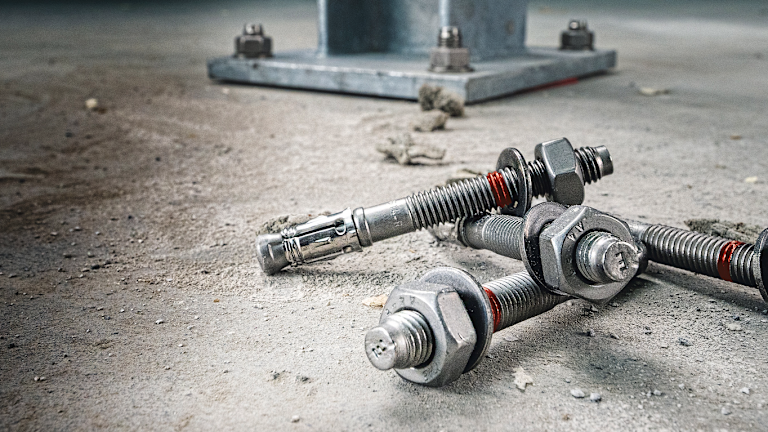
INTRODUCTION
Stud anchors are widely used for fast and reliable fastening to concrete, and are especially suitable for baseplate fixing, façade brackets, and curtain walls, as well as service fixings in civil infrastructure (e.g. tunnels, bridges, noise barriers) and industrial fastenings (e.g. machine and conveyor belt fixings). However, stud anchors have shown limitations in terms of performance and design flexibility when compared to cast-in or chemical anchors.
HST4 is the latest innovation from Hilti, bringing stud technology beyond existing anchor approval standards for post-installed anchors, while meeting the evolving needs of both specifiers and contractors.
Hilti is committed to giving specifiers higher performing anchoring solutions, which allow for value-engineered and optimized design, securing more peace of mind to translate what they specify into well-executed applications on the jobsite.
HST4 is the result of Hilti’s continuous innovation and research, building on the success of our previous portfolio of stud anchors, such as HSA, HST2, and HST3. The anchor line is available in carbon steel (HST4) and stainless steel versions (HST4-R), offering anchoring solutions for indoor and outdoor applications where corrosion resistance is required.
Opting for HST4 will enable you to optimize baseplate designs, helping to reduce the total cost of ownership and enhancing sustainability for your applications. This is thanks to:
An innovative design that allows for improved resistance to concrete cone failure – up to the level of cast-in headed fasteners – and higher pullout capacity than ever before. This means engineers can now rely on smaller anchor diameters, achieve smaller spacing and edge distances, and further optimize their baseplates. These types of improvements ultimately help to reduce costs and increase sustainability;
The assessment of variable embedment depth, enabling the optimization of anchor lengths to precisely match your load requirements;
A broad range of approved assessments for different load conditions – static loads in uncracked and cracked concrete, seismic C1 and C2, as well as fire loads – as well as compatibility with Hilti’s installation systems, that are less prone to human errors. Just one example is Hilti’s Adaptive Torque Module which automatically provides the correct torque for your specific anchor. This will help to ensure that on the jobsite you get exactly what you specified.
HST4: OUR HIGHEST PERFORMING WEDGE ANCHOR
Concrete cone failure and pull-out failure are two of the most critical failure modes for mechanical anchors under tension.
Concrete cone failure occurs when the concrete around the anchor cracks and breaks out in a cone shape. This happens due to the stress induced in the concrete by the forces transmitted from the structure through the fastening point. The design method for calculating the concrete cone resistance of mechanical anchors is provided by EN 1992-4 [1], which is the European standard for designing fastenings for use in concrete.
According to EN 1992-4, the characteristic resistance of a group of fasteners in the case of concrete cone failure is obtained by multiplying the characteristic resistance of a single anchor placed in concrete (and not influenced by adjacent fasteners or edges of the concrete member), N0Rk1c, , by a series of coefficients that account for the influence of various factors. These account for variables such as the distance from the slab edge, the spacing between anchors within a group, load eccentricities and bending moments, and the presence of dense reinforcement.
In particular, the characteristic resistance of a single anchor N0Rk1c, , is dependent on both the concrete strength and the embedment depth of the anchor itself, as given by the following formula [1]:

where fck represents the nominal characteristic compressive cylinder strength of the concrete, and hef is the effective embedment depth of the anchor. The coefficient k1, which linearly influences the concrete cone characteristic resistance, is, in general, indicated in the European Technical Assessment of the anchor. According to current market standards and also indicated in the EN 1992-4, this factor typically assumes values of 7.7 for cracked concrete and 11.0 for uncracked concrete for post-installed fasteners, and 8.9 for cracked concrete and 12.7 for uncracked concrete for cast-in headed fasteners.
Hilti HST4 is the first stud anchor in the world to achieve the same concrete cone resistance as a cast-in headed fastener, with a k1 factor 8.9 for cracked concrete and 12.7 for uncracked concrete for select sizes thanks to its innovative design. This means that HST4 can reach the same concrete cone load capacity as other stud anchors with a shorter embedment depth, or can achieve a ~16% higher load capacity with the same embedment depth. What does this mean in design practice? It means that you can now use shorter anchors for the same application, or design for higher loads using the same anchors.
HST4 has 4 key components that contribute to its superior performance (see Figure 1):
Turbo-channels and interlock, which provide additional interlock resistance with the sleeve;
A highly engineered sleeve with a tip groove design, a longer four-segment shape and a tapered tip, which maximizes the grip to the concrete and helps to prevent slippage;
A turbo-mountain-valley shape, which maximizes the sleeve expansion, enabling strong performance in both uncracked and cracked concrete as well as in seismic conditions, and provides more reliability with an anti-spinning sleeve;
Tailored and proprietary top-coatings for the bolt and the nut, which are optimized for tension loads and allow for close-to-the-edge installation.

Figure 1: HST4 innovative design
The innovative design of HST4 further provides a higher pullout capacity in both uncracked and cracked concrete, under both static and seismic loads. Compared to our previous generation of stud anchors, for a single anchor with the same length and diameter, HST4rovides a tensile performance increase of +36% to +84% in uncracked concrete under static conditions, +18% to +41% in cracked concrete, and +11% to +63% under seismic C2 loads, depending on the diameter of the anchor.
VARIABLE EMBEDMENT DEPTH: OPTIMIZE YOUR ANCHOR LENGTH
The embedment depth of an anchor in concrete determines both the load transfer mechanism and failure mode of the anchor. In general, the deeper the embedment, the higher the load capacity of the anchor. The downside is that a deeper embedment also results in longer drilling and setting time, as well as a higher risk of hitting rebars.
Most stud anchors are approved for fixed embedment depths, typically between 1 and 3 values. This limits the flexibility and optimization potential for both the anchor selection and design, as the structural engineer is required to choose from a predefined set of anchor lengths and embedment depths, which may result in over-designing the fastening point.
HST4 is qualified according to the new European assessment documents, EAD 330232-01-0601 v02 [2], which covers the improved resistance to concrete cone failure, and EAD 330232-01-0601 v03 [3], which covers the use of variable embedment depth for mechanical anchors fastened in concrete. This means that, with HST4, the embedment depth can be freely selected within given ranges (as specified in the European Technical Assessment document ETA-21/0878 [4]) according to the selected anchor diameter and load requirements, as shown in Table 1.

Table 1: Effective embedment depth ranges for HST4
With variable embedment depth, structural engineers can select the optimal anchor length and embedment depth for their applications, getting the best value for money for their anchors, which helps saving on material and reducing installation costs.
HST4 can be designed using the Hilti PROFIS Engineering software, which is a cloud-based software that integrates with structural suites and aids in the design and optimization of fastening points and baseplates. With PROFIS Engineering, Hilti provides a user-friendly interface, a 3D modelling environment, a report generator, and technical support service. PROFIS Engineering implements the EN 1992-4 design method and includes all the features and benefits of HST4, such as improved concrete cone resistance, variable embedment depth, and no-cleaning installation.
HST4: UNLOCKING THE POWER OF VALUE ENGINEERING
The higher tensile performance of HST4, combined with the use of PROFIS Engineering software, helps you to optimize your fastening solutions, to reduce the size of your baseplates, lower your costs, save on materials, and make your designs more sustainable. The use of smaller anchors and the higher concrete cone performance of HST4 make it possible to use smaller anchor spacings, which, in several instances, allows for a reduction in the overall size of the baseplate.
As a simple example, let’s consider the 10mm thick baseplate shown in Figure 2.
This is a steel baseplate subjected to a static tensile 50kN force. The concrete member is of the C20/25 concrete strength class, and is 250mm thick, and is considered as cracked concrete.

Figure 2: Baseplate in tension with traditional stud anchoring solution
A ‘traditional’ stud anchor solution would require four M12 stud anchors, with an effective embedment depth of 88mm, an anchor length of 125mm, and an anchor spacing of 165mm, resulting in a baseplate size of 200mmx200mm. Placing the anchors closer to each other, for example at a spacing of 160mm, will require the use of longer and more expensive anchors.
How can you now optimize with the HST4?
OPTION 1: Thanks to the higher pullout capacity of HST4, it is possible to reduce the anchor diameter size from M12 to M10. This already allows for a reduction in both the material and cost of the anchors.
Simultaneously, with the improved concrete cone capacity and the use of variable embedment depth, it is also possible to reduce the anchor length, by using a shorter effective embedment depth of 71mm. This shorter embedment will even provide the same concrete cone capacity as the original design.
OPTION 1 BENEFITS: The use of smaller anchor diameters results in smaller diameter boreholes, and the use of shorter anchors results in shorter drilling depth, helping to reduce both installation time and costs on the jobsite.
OPTION 2: However, to truly maximize your value, it is possible to maintain the anchor embedment and reduce the anchor spacing instead. The same performance can now be achieved with four M10 anchors, with the same effective embedment depth of 88mm as before, but with a smaller anchor spacing of 135mm. The improved spacing allows for a reduction in the baseplate size to 165mmx165mm.
OPTION 2 BENEFITS: The optimized baseplate is 30% smaller which translates to a 30% reduction in the volume of steel used!

Figure 3: Specifications with HST4-R – best value for money with baseplate optimization
MORE PEACE OF MIND WITH HST4
BUILDING SAFETY AND CONNECTING THE DESIGN TO THE JOBSITE EXECUTION
Building Safety is a key target of designers globally and at Hilti we are committed to supporting you. We partner with academia and regulatory bodies to define and extend industry standards and elevate practices through education on design methods. We also develop design methods and software to help you design for safety.
We have also coupled our HST4 technology with better installation methods to help provide more peace of mind that your design is executed correctly on the jobsite. Compared to traditional installation for stud anchors, the HST4 stud anchors can be installed with fewer installation steps and innovative systems. HST4 anchors are approved for non-cleaning installation which means you do not have to clean the borehole prior to installation. In addition, HST4 anchors can be properly set using our Adaptive Torque (AT) Module instead of a traditional torque wrench.
By specifying with Hilti installation systems and solutions, you can make jobsite practices faster, simpler, and safer compared to traditional methods. You can also feel more confident about the installation and reduce the need for redesign or rework. Our field team is also available to support you with trainings in your office or on your jobsite to help enable proper installation, turning your specification into reality.
MORE SUSTAINABLE WITH HST4
HELPING YOU MAKE YOUR DESIGNS MORE SUSTAINABLE
By optimizing your structural connections with our HST4 system, you have the ability to reduce the amount of steel used and, more specifically, make your designs more sustainable. As shown above, thanks to the higher performance, you can reduce the steel by downsizing the diameter of the anchor needed for your design. In certain applications, you may even be able to reduce the size of your baseplate. Any reduction in steel equates to CO2 savings and, therefore, more sustainable designs. HST4 also is supported with documentation that supports you in meeting your project’s environmental standards and green building certifications.
CONCLUSIONS
HST4 is the latest Hilti innovation in stud anchors, achieving performance that matches cast-in headed fasteners. HST4 is a high-performing stud anchor with a unique design that allows for variable embedment depth and improved resistance to concrete cone failure, ultimately resulting in a tensile resistance higher than ever before. It has a broad approval range to cover your application requirements and ensure code compliance. It is compatible with Hilti's installation systems, supporting a reliable installation.
HST4 helps enable the optimization of baseplate designs, making your design specifications better; Design specifications that are higher performing, value engineered, more sustainable, and bring you more piece of mind.
HST4: the stud anchor that allows you to do more with less.
REFERENCES [1] European Committee for Standardization. (2018). EN 1992-4:2018 Eurocode 2: Design of concrete structures - Part 4: Design of fastenings for use in concrete. Brussels, Belgium. [2] European Organisation for Technical Assessment. (2021). European Assessment Document (EAD) 330232-01-0601: Mechanical fasteners for use in concrete. Brussels, Belgium. [3] European Organisation for Technical Assessment. (2023). European Assessment Document (EAD) 330232-01-0601-v02: Improved resistance to concrete cone failure for mechanical fasteners for use in concrete. Brussels, Belgium, to be published. [4] European Organisation for Technical Assessment. (2023). European Assessment Document (EAD) 330232-01-0601-v03: Mechanical fasteners with variable embedment depth for use in concrete. Brussels, Belgium, to be published. [5] Centre Scientifique et Technique du Bâtiment. (2023). European Technical Assessment ETA-21/0878: Hilti HST4-R. Marne la Vallée, France.
To explore more engineering topics, please visit and register with our Engineering Center!